Originally written for BA Curating core module Museums, Galleries, Exhibitions.
Performance and Provocation
‘Why not whip the teacher when the student misbehaves?’ – Diogenes the Cynic (404-323BC)
What right does a person have to break the rules? What constitutes a healthy disregard for authority? A Christmas holiday in Greece led me to ask these questions after some initially unforeseen confrontations with staff in various museums and heritage sites. It led me to consider the expectations of behaviour in public cultural places, and how they clash with inspirations and responses of a visitor. What one can and cannot, should and should not do in a museum environment.
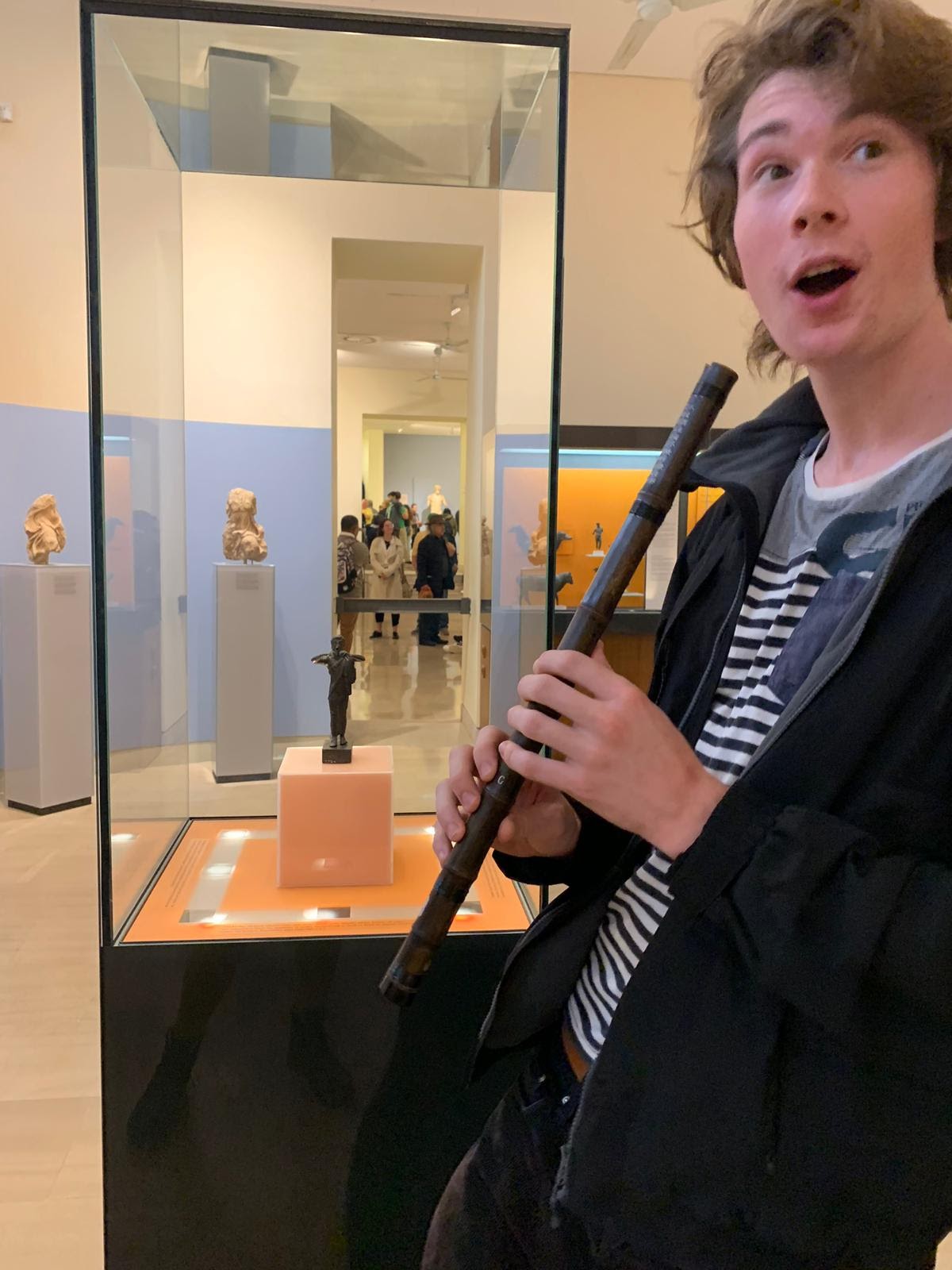
These thoughts were prompted head on in the archeological museum of Delphi, when seeing a small statue of a flute player in a glass cabinet. I had recently taken up playing a Chinese flute and had it with me. I felt a resonance with this statue which had imitated what so long ago is still practiced today, by me, I wanted to enact what was in the glass case as a small tribute to this historical connection. I asked my brother to take a photo of me as I was taking my flute out, when an invigilator promptly and resolutely walked over to us, asking me to put it away and not to get it out again (fig. 1). I was hurt by this interaction as I was not deliberately

trying to break any rules. I wanted to pay homage to this Greek relic in a way I saw fitting and appropriate but was chided for doing so.
Onwards from Delphi and to the Peloponnese, wherein lies amongst the hills the ancient Theatre of Epidaurus. This is one of the best preserved theatres of ancient Greece, a great testament to the society’s architectural skills and acoustic understanding – supposedly a coin drop can be heard from the widest rows at the top of the large semicircular space (fig. 2 and 3). Epidaurus is open for the public to explore and the huge open architecture and freedom to stand on the stage and roam amongst the ascending rows of stone seats, invites some feeling, and desire for performance. I am a recreational juggler, and having heard we were going to an outdoor theatre I brought my juggling balls with me. When I entered the theatre I started to juggle on the


stage, which caused a whistle to be blown from behind me and a guard telling me to stop, and if we had taken any footage then we were to delete it. During the rest of our time there she prevented my family and other visitors for walking too quickly, whistling, and singing (‘No music!’). In the summer months a festival of Greek theatre is held, so this harsh reaction understandably led to some frustration. Visitors are allowed to experience and be affected by this space, but are reprimanded for any responses deemed too expressive (presumably not on those grounds, but no grounds were given; ‘It’s the rules.’ was the only response). We were in a strange corner of the ‘look don’t touch’ policy in museum culture.
This umbrage led me to take – rightly or wrongly – a step further, and juggle again. My brother and I hatched a plan to take some photos and a film while I did some more juggling on the stage. Within a few seconds the guard blew her whistle before telling me that I needed to leave, to take my family with me, and again to erase any footage we took.
I did not want to fully concede and delete the media, because this would achieve nothing for me or for the argument I am making. Neither will I show the full images, as I want to respect the site, the people responsible for it and their wishes. There needs to be some balance though, as neither of these extremes are desirable when applying this to the wider conversation of cultural protest. I settled on including these images, but with my presence in them censored (fig.4-8):


These rules were not always so strict. After some research, I found several Youtube videos of sightseers singing away on the stage, with the most recent video uploaded in Summer 2018. There is no whistle blown in this one or any of the others (with one exception from 2012), so since then perhaps someone may have pushed their liberties too far by the administrator’s standards causing the rules and enforcements to be tightened. I edited these films into a 3 minute video, to show the joy that the tourists are experiencing with their freedom to sing:https://www.youtube.com/embed/3-o9afsy8uY?version=3&rel=1&fs=1&autohide=2&showsearch=0&showinfo=1&iv_load_policy=1&wmode=transparent
In Ethical Considerations on the Presentation of Works of Art, Antoine Quatremère de Quincy wrote: ‘To what wretched destiny do you condemn art if its products are no longer tied to the immediate needs of society? Why are the religious and social uses of art objects now ignored?’ Applying this to the Theatre of Epidaurus, an argument can be made that reconciles de Quicy’s qualms; by showcasing theatre on an annual basis and teaching the ancient Greek’s connection of theatre to medicine (theatre to the Greeks was an important part of the healing process) is by many means keeping it connected to its religious and social uses. It is difficult to say that the argument does the same for my case, but I and others like me are part of society. De Quincy’s writing was from 1815. It still holds true today and being regarded as the cradle of western civilisation it may have done for the ancient Greeks, so perhaps this is how it has always been in western society, that an individual’s self expression is inevitably shadowed by the larger cultural system. This alone justifies the right to rebel against a cultural traditions, and if we are to see this in context of the binary positions of spectator and performer, then French philosopher Jacques Rancière supports this view: ‘What human beings contemplate in the spectacle is the activity they have been robbed of; it is their own essence become alien, turned against them, organizing a collective world whose reality is that dispossession’. There are only dispossessed spectators in the Theatre of Epidaurus, a wandering audience with no performers. The consequence that performances emerge from this vacancy I see as a beautiful thing.
Back in England, I went to visit the Victoria & Albert Museum. Juggling balls in bag and with a similar but more diplomatic intention, I found the ‘Theatre and Performance’ display rooms and asked an assistant what his response might be if I was to start juggling. In striking contrast to the museums I visited in Greece his attitudes were encouraging of these kinds of behaviours. We were standing next to a ‘rehearsal room’ (fig. 9) which had been installed to

incite passers by to practice whatever performative compulsions were inspiring them. There used to be a bar in front of the mirrors but it had become loose after so many people using it for ballet. ‘People dance here more than anything else’. He said as long as I wasn’t making anyone uncomfortable or damaging objects then it would be fine. He was happy to take a photo of me (fig. 10). I learnt that the V&A generally, and this department in particular, are trying to shift away from the expressive confinements that is the permanent display, with a more active, participatory goal in mind.
The paradox of the spectator is ‘to be separated from both the capacity to know and the power to act’. The classic permanent display does little to alleviate this paradox; glass cabinets physically separate the spectator from engaging with objects, which in turn will place an arbitrary limit on their capacity to have a more engaging, human experience. Particularly when it comes to theatre and performance, the material objects are not as important were it another art form. In order to have a more suitable learning experience, visitors need to have the opportunity to in some way embody these performing arts. This is a huge difficulty with no easy solution that many museums are struggling with. Photography used to be banned at the V&A only a few years ago, but today – largely due to the rise of Instagram – it is encouraged. As well free advertising for the museum,

it is a method of self interpretation that provides the opportunity to share new and unique experiences. The rise of Instagram is not without its downsides, but it may indicate an oncoming shift towards democratisation of artistic licence to the participant.
The V&A is a vastly different organisation to the places I visited in Greece, and using one’s policies to hold the other’s to account would be to misconstrue them. This accompanying experiment was an attempt to understand the broad range in attitudes to the power that a visitor has in cultural spaces, and what happens should they test that power.
Under analysis my performance contains a criticism of the ingrained mindset of how culture is taken in. It asks for a shift in perspective and inclination to generate new ways of interpretation. Once something is represented in a museum, it is the spectators that make it, that change it’s meaning. The Inside is the Outside by Lygia Clark is analogous of this; a stainless steel sculpture that was envisioned to be shaped and reshaped by the art goers.
Which is more important, new ways of being or the old? As Paul Valery says in The Problem with Museums, when experiencing art in a museum, we must not grow erudite: ‘erudition, in art, is a kind of dead end: throwing light on what is least refined, investigating the nonessentials.’ To accept my juggling using this thinking is to bring life and soul into often cold, static museum scenes. From Valery’s so called dead end a new direction is sprung. Artists need space to rebel, and will always find it. The real challenge is how to make the act of rebellion worthwhile, so that it can change attitudes.
Bibliography
Books
Herakleitos and Diogenes (2011). ‘Herakleitos and Diogenes: Translated from the Greek by Guy Davenport’. p.55, Wipf and Stock Publishers
Quatremère de Quincy, Antoine. Ethical Considerations on the Presentation of Works of Art. 1815 (Paris: Artheme Fayard, 1989) translated by Jean-Paul Martinon.
Ranciere, Jacques. The Emancipated Spectator. London: Verso, 2009. Translated by Gregory Elliot, 2009.
Valery, Paul. ‘The Problem with Museums’, in Degas, Manet, Morisot, 1934, translated by David Paul London: Routledge and Paul Kegan, 1972.
Websites
Athens and Epidaurus Festival: https://whyathens.com/events/epidaurus-tickets/
Diagram of the Theatre of Epidaurus:
https://www.theatre-architecture.eu/en/db/?theatreId=355
Lygia Clark: https://www.moma.org/collection/works/133319
Singing in Epidaurus Sources
Playlist of videos used: https://www.youtube.com/playlist?list=PLs6g6oTRurxxEJVe5qSUyCS-uZj7pZn2A
Erik Bennett, Denise at Epidaurus, https://youtu.be/E_7ng3zwlkc
Alyssa Bouma, Singing at the Theater of Epidaurus, https://youtu.be/zOQJwwusHlw
Alyssa Bouma, ‘Terry Bouma singing at the Theater of Epidaurus’, https://youtu.be/u_7iRQudT0o
A, BRISY, ‘Singer in Epidaurus theatre 🎭’, https://youtu.be/Szq88R7Y-wg
Andrew Coulson, ‘Singers at Epidaurus’, https://youtu.be/kzVeGlrySOk
Vanessa DeKoekkoek, ‘Singing in the Theater of Epidaurus!’, https://youtu.be/bTX88cNwOek
Vanessa DeKoekkoek, ‘Singing in the Theater of Epidaurus!’, https://youtu.be/JlQkhDhMVgo
Vanessa DeKoekkoek, ‘Rachel and Sarah singing in the Theater of Epidaurus!’, https://youtu.be/ceVNfAo6WJY
Vanessa DeKoekkoek, ‘Singing in the Theatre of Epidaurus until the guard blew his whistle!’, https://youtu.be/VZ4fzod-KcI
Manouchehr Khosrowshahi, ‘May Wright Singing at Epidaurus: Greece’, https://youtu.be/q-KI5BoY9uU
Maria Lianos-Carbone, ‘Singing in the great Theatre of Epidaurus’, https://youtu.be/wspQ9nqPtLU
lingloolid, ‘epidauros singing haa’, https://youtu.be/F_OgNQ3QJgk
nedzima, ‘epidaurus lee singing’, https://youtu.be/XY6b94M363U
rbrack213, ‘Canada Girls Sing at Epidaurus’, https://youtu.be/efP4LweHuu0
tamerajuana, ‘Epidaurus’, https://youtu.be/r_gmJbJXGCE
Alyssa Tieman, ‘Greece 2012 – Kelsie at Epidaurus’, https://youtu.be/DKuouHqB8G0
John Welsh, ‘Nicholas Yiannarakis sings L’altra notte on the theatre of Epidavros’, https://youtu.be/jtrBxoRlWE0
Peter Zhong, ‘Singing at the Ampitheater Epidauros’, https://youtu.be/M9OJ6w3JeR0
 Goldsmiths BA Curating