This event is part of Care and Knowledge Cannot Exist Without Struggle, Goldsmiths BA Curating’s 3rd year Public Programme and Launch Events, Summer 2020
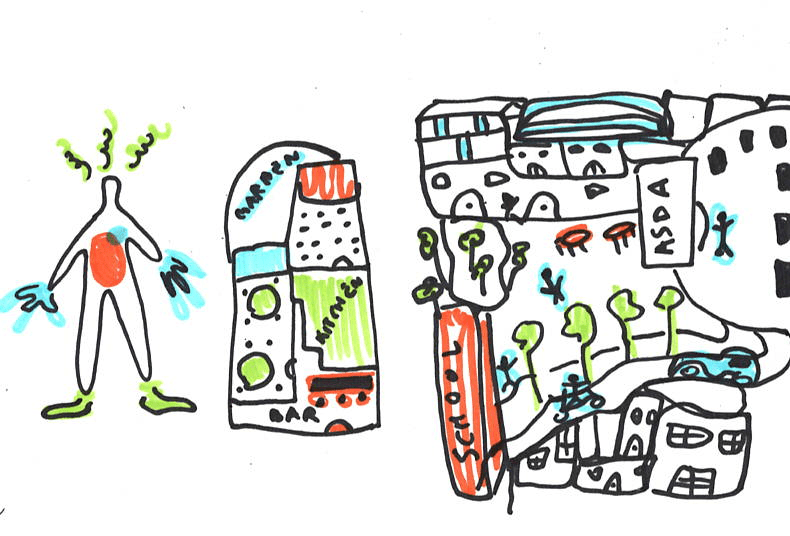
“MAPPING AUTONOMOUS SPACES”: DIY Space for London in conversation with Ginevra Naldini, third year student of Goldsmiths BA Curating.This event will be a conversation-based workshop addressing the challenges and potentialities of collective work within autonomous cultural institutions in South East London. Mapping the body, the institution and the community we will discuss how these intersect and inform each other? What impact do these dynamics have on our mental and physical wellbeing? How do we organise for social transformation through artistic practices and spaces? Bring an object to the discussion, this will work as material witness of your collaborative experiences and as introductory activity!DIY Space For London is a cooperatively-run social centre located in South London, just off Old Kent Road. They offer low cost creative facilities, meeting rooms and social space as well as space for screenings, talks and performances. They run on a members’ club model so that everyone has equal say in how the place is run. The space works to promote the ideas of mutual aid (helping each other) and cooperation (working together). Providing a welcoming space for everyone, including those whose voices and contributions are not always heard or appreciated, is a top priority for DIY.
This is the Eventbrite link, the event will be hosted via zoom.
Originally written for BA Curating module Seeing and Showing.
Simon Fujiwara, A Conquest – Dvir Gallery, Brussels – Exhibition Review
Bigotry: A curable disease?
A Conquest is an exhibition by Simon Fujiwara, currently on show at the commercial Dvir Gallery in Brussels, Belgium. Simon Fujiwara (b. 1982) is a British / Japanese conceptual artist based in Berlin. The exhibition explores Fujiwara’s personal experience of having contracted syphilis. The pieces are exhibited in a manner that communicates a narrative arc that begins at worship and continues to control, devastation, and ends with salvation. Through this narrative, the project humanises the taboo topic of sexually transmitted illnesses (STI) by acting as an open invitation for discussion, by using parody to question religious and historical means of societal control, and through Fujiwara’s stand in solidarity with others to have suffered the infection.
Fujiwara’s previous works have focused on themes of politics, personal and shared identity. Though A Conquest also plays on these themes, it is also a departure from his previous exhibitions. Whereas exhibitions such as Hope House and Joanne received critical acclaim for the manner with which he presented sensitive topics that he was emotionally or intellectually attached to, A Conquest is the first exhibition created by Fujiwara in which the protagonist that serves as inspiration for the works, is Fujiwara himself. This no doubt contributes to the narrative arc that one infers from his work; this exhibition is a personal account with a beginning and an end.
The exhibition’s topic and manner of its conception firmly place Fujiwara in the realms of the Avant-Garde in terms of his approach, but also the societal context in which he created his works. Fujiwara is radical and his pieces challenge the conservatism of our society; STIs are still taboo. Further, the revolutions of 1848 that proceeded the avant-garde, can be compared to the modern advancement of medicine and treatment of STIs. Whereas the former was a victory for democratic ideals that could be realised in art, the latter is a celebration of medical advancement that has been shown to reduce the internalised stigma attached to STIs and HIV in particular, through the development of pre-exposure prophylaxis (PrEP). Post-1848 artists such as Delacroix, Courbet and Papety, produced radical art that espoused ‘progressive ideals’. Fujiwara’s art post-PrEP similarly heralds ‘progressive ideals’; a liberal attitude towards promiscuity that runs counter to modern society’s views.
How Fujiwara’s exhibition is housed within a polished-white cubed space, will be analysed alongside the effect of his narrative arc, and the effectiveness of his pieces in inviting a discussion that will erode the taboo of STIs, and question the power of religious and historical structures.
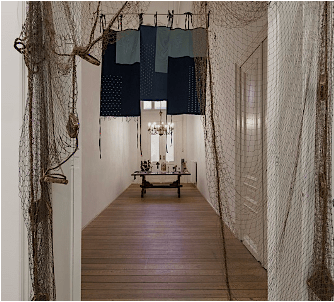
Dvir Gallery Brussels is situated on the first floor of Rue de la Regence 67, in a former printing house that also hosts seven other galleries. It is not a gallery for the window-shopper; one cannot stumble across Fujiwara’s exhibition; it must be sought. The stairwell from which the Dvir Gallery is entered, acts as a palate cleanser. Its neutrality prepares the eyes and mind, acting as an extended threshold over which one steps before becoming immersed in the exhibition.
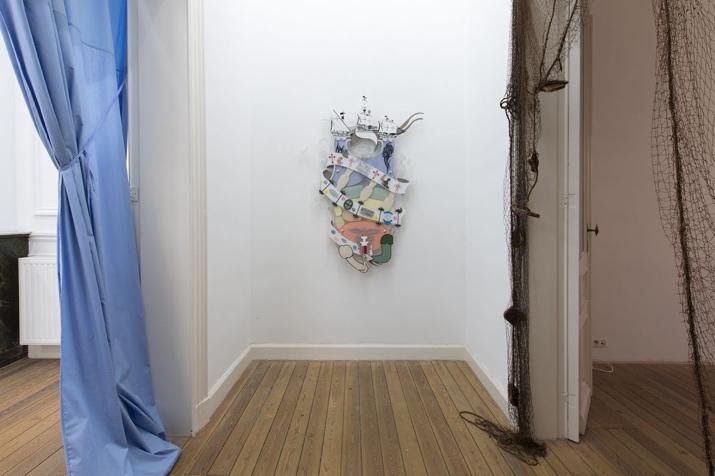
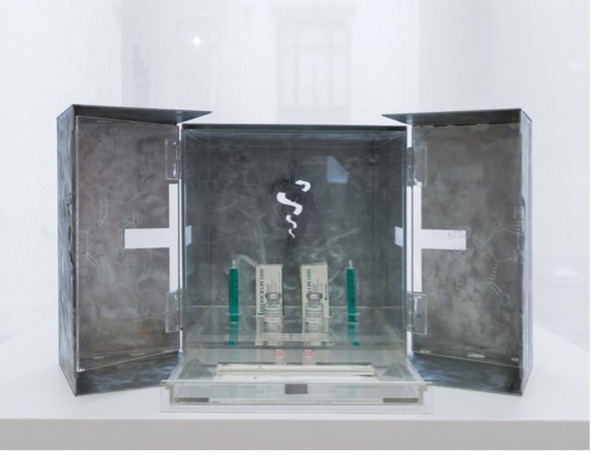
Entering the gallery brings one into direct and uninterrupted contact with A Conquest, with the exhibition incorporating the foyer and four distinct rooms. The foyer holds A Conquest: Syphilis (Fig. 1), a piece that resembles a coat of arms, bringing to mind the humanising effort that Fujiwara is making. Fujiwara comments himself that, syphilis is his, ‘badge of honour’: he identifies and stands in solidarity with other sufferers. Progression through the gallery is linear, with no option but to move from room One-Four. This progression reinforces the narrative arc.
Figure 1: Simon Fujiwara, Syphilis: A Conquest, 2020
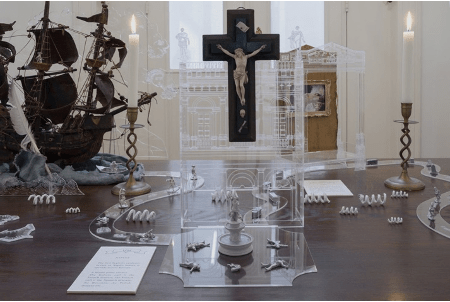
Room One is reminiscent of the central aisle of a church’s nave, imbuing the space with a ritualistic quality. Just as the central of aisle a church is defined by the placement of pews that lead to an altar, Room One – the worship phase of the narrative arc – is defined by its narrow and rectangular dimensions, at the end of which ‘Why do I have Syphilis? (A brief history) is located (Fig. 2). An antique table forms the basis of the piece, upon which by two candles are lit and a crucifix stands in centre of the surface. The ritualistic qualities of the space are exacerbated by the table’s age, the lighting, and the religious iconography, yet though Room One is where the first phase of the narrative arc is established, it is not a place where God is worshipped. Altars are created in the name of those that we are subject to; we implore with those we perceive as subjugating our self-control; the subjugator in Fujiwara’s piece, is syphilis. The piece is a record of the history of syphilis, one that denotes a sense of surrender, but also an attempt at understanding.
Figure 2: Simon Fujiwara, Why do I have Syphilis? (A brief history), 2020
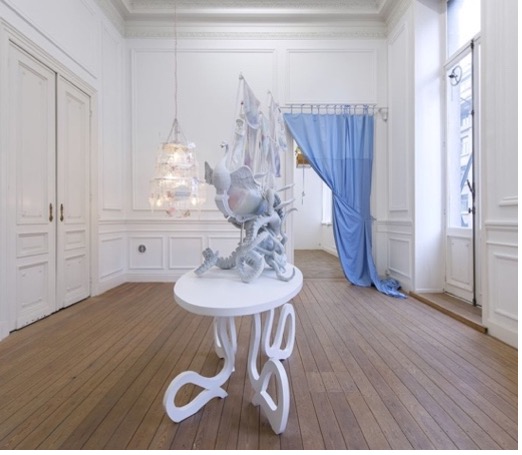
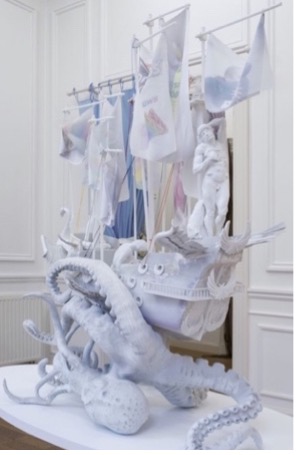
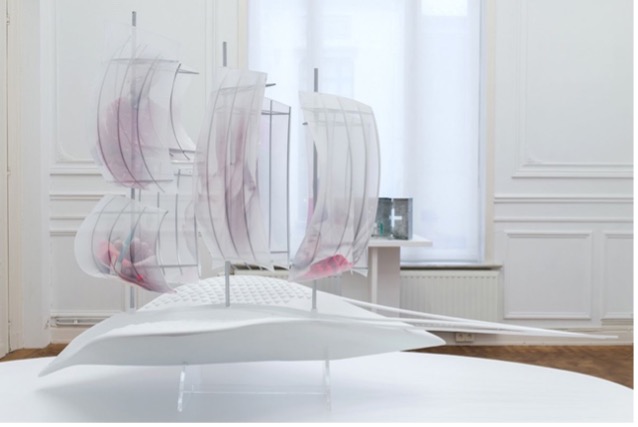
Separating rooms One and Two are sky blue curtains, a colour that projects both heavenly symbolism and serenity (Fig 1 & 3). The curtains are also reminiscent of the blue colouring of PrEP: the curtains serve as a reminder of the ritualistic qualities and worship of Room One, but also a promise of the STI endemics that precipitated medical advancement. Room Two – the control phase of the narrative arc – is filled with a natural light that works with the pieces to project impressions of hope and purity. SS Delirium (Fig. 3) appears to float in the centre of the room. This is the first of a three-part series of ships that describe Fujiwara’s personal journey with syphilis. SS Delirium is a reference to the voyages of Christopher Columbus to the New World, where it is posited that syphilis was contracted before being brought back to Europe. Columbus’s voyage is celebrated for his discovery, but the colonialising and economic motivations are referenced in the piece’s decoration, with reference to Lloyds bank, Visa, and the Coca-Cola company on the ship’s sails: commercialism drove Columbus and maintains a controlling grip on modern society. These appear alongside a washed rainbow motif that alludes to the LGBTQ+ community, and the slogan, ‘WE BOTH TAKE PrEP: WHAT’S YOUR RULE?’.
Figure 3: Simon Fujiwara, SS Delirium, 2020 & Figure 4: Picture of a PrEP Pill, 2020
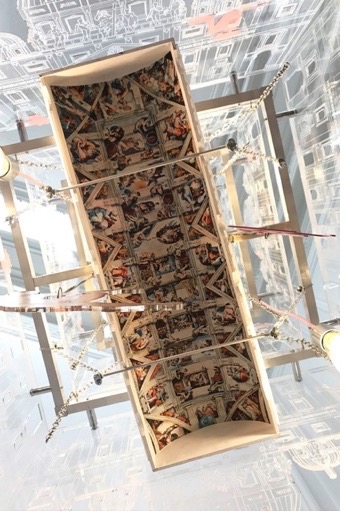
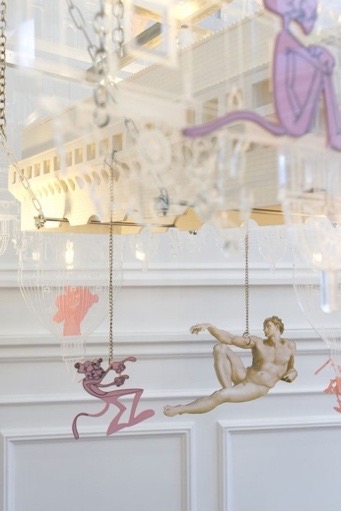
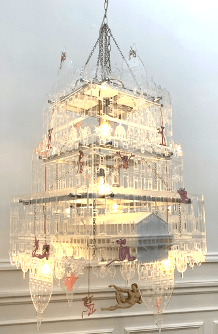
Pink Panther vs The Pope (Fig. 5) is the second piece in Room Two and appears as though a delicate, white chandelier, radiating with yellow light. The lowest hanging part of the chandelier is modelled on the Sistine Chapel. The interior is a scaled replica of Michelangelo’s famous fresco, whilst the exterior is adorned with images of the Pink Panther in what the artist describes as, ‘an epic takeover’. The dominant trimming of the chandelier is a parody of The Creation of Adam, where the image of God is replaced by an image of the Pink Panther. The piece references the societal control exerted by the Church in the 15th Century, but the insertion of popular culture results in iconoclastic imagery that treats religious control in the modern day with contempt. The piece begins a dialogue: does religion still hold the moral high ground on the subject of promiscuity?
Figure 5: Simon Fujiwara, Pink Panther vs The Pope, 2020
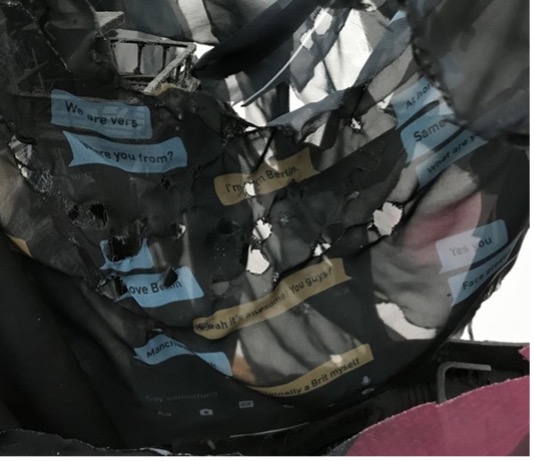
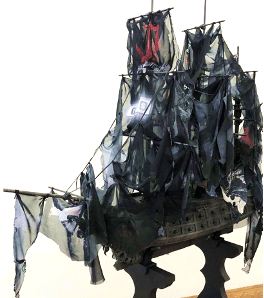
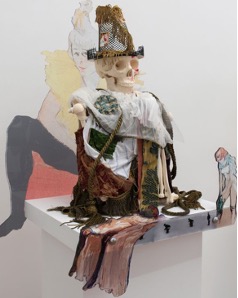
Room Three – devastation – moves the viewer into a darker and more visceral stage of Fujiwara’s infection. The works are a raw portrayal of his experience with the disease. SS Contagion (Fig. 6) – the second of the three-part ship series – carries explicit references on its sails to sex and the gay scene of Berlin; the sails drive the viewer into the sphere of where and how Fujiwara may have contracted syphilis. The dark colourings of the ship are a stark contrast to the heavenly blue curtains separating worship and control, they evoke a sense of despair. Adjacent to SS Contagion sit the four ‘Disney-fied’ skeletons of Goya, Van Gogh, Toulouse-Lautrec and Gaugin. (Fig 7) Each are suspected of having suffered syphilis, and their Disneyfication are further examples of Fujiwara taking influence from popular culture, but in this instance to humanise the endemic. Whilst the skeletons arouse sensations of the manic, Fujiwara actually stands in solidarity with these artists, questioning if he now belongs to a select family.
Figure 6: Simon Fujiwara, SS Contagion, 2020 & Figure 7: Simon Fujiwara, Syphilitic Comrades (Lautrec), 2020
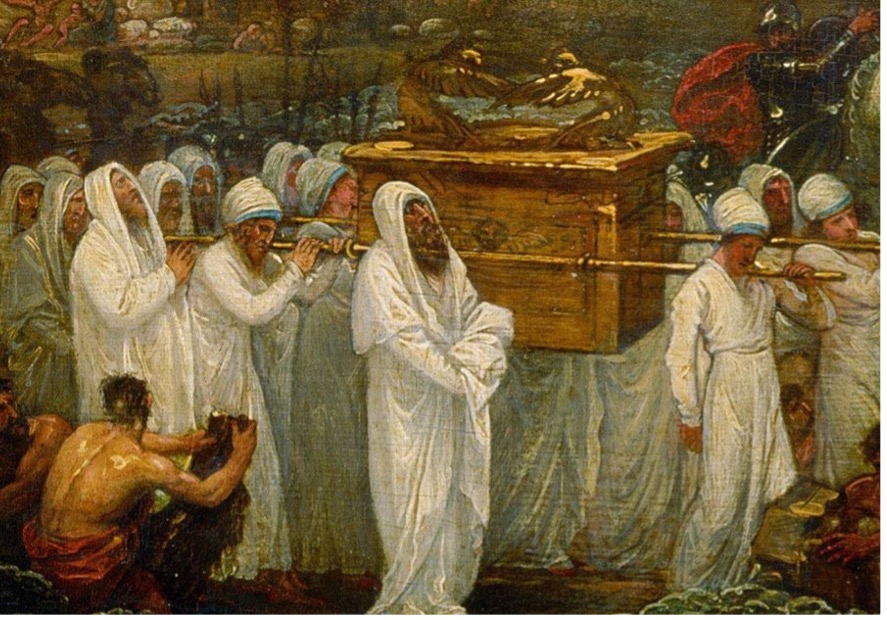
Upon entering Room Four – salvation – the despair and dark colourings of the previous room are replaced by the white of purity. The Ark (Fig. 8) forms the focal point of Room Four and is Fujiwara’s modern interpretation of The Ark of the Covenant (Fig. 9). The discovery of a new covenant completes the narrative arc, with religion displaced; the Ten Commandments are replaced by a representation of penicillin – the cure for syphilis – and a new objective truth: Science. Carol Duncan wrote: ‘Secular truth became authoritative truth; religion, although guaranteed as a matter of personal freedom and choice, kept its authority only for voluntary believers.’ For Duncan, museums belong to the realm of secular knowledge and Fujiwara’s exhibition can be interpreted as a microcosm of Duncan’s views, with the viewer moving in a linear fashion from worship to the salvation of science.
Figure 8: Simon Fujiwara, The Ark, 2020 & Figure 9: Benjamin West, Joshua passing the River Jordan with the Ark of the Covenant, 1800
The third part of the ship series is also in Room Four. The design of SS Salvation (Fig. 10) is futuristic, a yacht with sails that document Fujiwara’s visits to, and subsequent treatments, at the genitourinary medical clinic. SS Salvation conveys an overwhelming feeling of having ‘completed’ a journey.
A Conquest by Fujiwara is important. Jen Gunter wrote: ‘Why should it be any more shameful to catch an infection from sex than it is from shaking hands, a kiss or being coughed upon?’ That taboo and stigma underpin this sense of shame, necessitates a higher degree of education and conversation; A Conquest is an exhibition that invites dialogue, that questions religious and historical means of control, and utilises personal experience to offer a stand of solidarity. One may ask, if traditional systems of order and thought, are superseded by medical advancements, or if they still pervade our modern lives through the stigma that remains entrenched.
Figure 10: Simon Fujiwara, SS Salvation, 2020
Bibliography
Duncan, Carol. “The Museum as Ritual” in Civilising Rituals: Inside Public Art, 7-20.
Oxford: Psychology Press, 1995.
Fujiwara, Simon. “Why Syphilis now?”, Essay by artist, sent out via e-mail by Dvir Gallery, April 10, 2020.
Figure 1: Simon Fujiwara, Why do I have Syphilis? (A brief history), antique table, found objects, fabric, plexiglas, metal and plastic figurines, paper, lamp, 200 x 87 x 130 cm
Figure 6: Simon Fujiwara, Syphilitic Comrades (Lautrec), found objects, skeleton, antique fabric, digital print on plexiglass, metal mesh, paper, paint, 43 x 52 x 90 cm, 2020
Originally written for BA Curating core module Museums, Galleries, Exhibitions.
Performance and Provocation
‘Why not whip the teacher when the student misbehaves?’ – Diogenes the Cynic (404-323BC)
What right does a person have to break the rules? What constitutes a healthy disregard for authority? A Christmas holiday in Greece led me to ask these questions after some initially unforeseen confrontations with staff in various museums and heritage sites. It led me to consider the expectations of behaviour in public cultural places, and how they clash with inspirations and responses of a visitor. What one can and cannot, should and should not do in a museum environment.
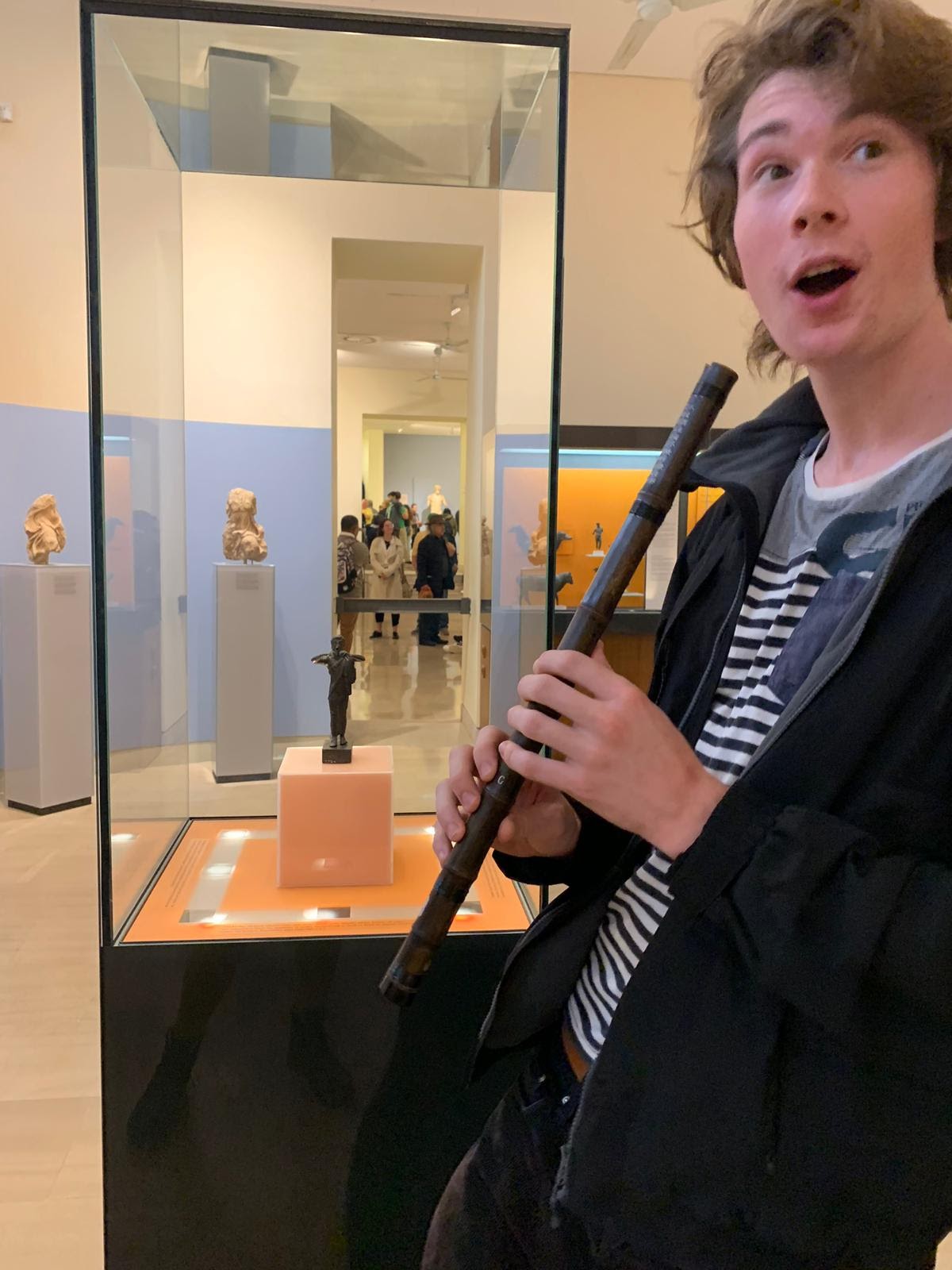
These thoughts were prompted head on in the archeological museum of Delphi, when seeing a small statue of a flute player in a glass cabinet. I had recently taken up playing a Chinese flute and had it with me. I felt a resonance with this statue which had imitated what so long ago is still practiced today, by me, I wanted to enact what was in the glass case as a small tribute to this historical connection. I asked my brother to take a photo of me as I was taking my flute out, when an invigilator promptly and resolutely walked over to us, asking me to put it away and not to get it out again (fig. 1). I was hurt by this interaction as I was not deliberately
(Figure 1)
trying to break any rules. I wanted to pay homage to this Greek relic in a way I saw fitting and appropriate but was chided for doing so.
Onwards from Delphi and to the Peloponnese, wherein lies amongst the hills the ancient Theatre of Epidaurus. This is one of the best preserved theatres of ancient Greece, a great testament to the society’s architectural skills and acoustic understanding – supposedly a coin drop can be heard from the widest rows at the top of the large semicircular space (fig. 2 and 3). Epidaurus is open for the public to explore and the huge open architecture and freedom to stand on the stage and roam amongst the ascending rows of stone seats, invites some feeling, and desire for performance. I am a recreational juggler, and having heard we were going to an outdoor theatre I brought my juggling balls with me. When I entered the theatre I started to juggle on the
(Figure 2)(Figure 3)
stage, which caused a whistle to be blown from behind me and a guard telling me to stop, and if we had taken any footage then we were to delete it. During the rest of our time there she prevented my family and other visitors for walking too quickly, whistling, and singing (‘No music!’). In the summer months a festival of Greek theatre is held, so this harsh reaction understandably led to some frustration. Visitors are allowed to experience and be affected by this space, but are reprimanded for any responses deemed too expressive (presumably not on those grounds, but no grounds were given; ‘It’s the rules.’ was the only response). We were in a strange corner of the ‘look don’t touch’ policy in museum culture.
This umbrage led me to take – rightly or wrongly – a step further, and juggle again. My brother and I hatched a plan to take some photos and a film while I did some more juggling on the stage. Within a few seconds the guard blew her whistle before telling me that I needed to leave, to take my family with me, and again to erase any footage we took.
I did not want to fully concede and delete the media, because this would achieve nothing for me or for the argument I am making. Neither will I show the full images, as I want to respect the site, the people responsible for it and their wishes. There needs to be some balance though, as neither of these extremes are desirable when applying this to the wider conversation of cultural protest. I settled on including these images, but with my presence in them censored (fig.4-8):
(Figure 4)(Figure 5)(Figure 6)(Figure 7)
These rules were not always so strict. After some research, I found several Youtube videos of sightseers singing away on the stage, with the most recent video uploaded in Summer 2018. There is no whistle blown in this one or any of the others (with one exception from 2012), so since then perhaps someone may have pushed their liberties too far by the administrator’s standards causing the rules and enforcements to be tightened. I edited these films into a 3 minute video, to show the joy that the tourists are experiencing with their freedom to sing:https://www.youtube.com/embed/3-o9afsy8uY?version=3&rel=1&fs=1&autohide=2&showsearch=0&showinfo=1&iv_load_policy=1&wmode=transparent
In Ethical Considerations on the Presentation of Works of Art, Antoine Quatremère de Quincy wrote: ‘To what wretched destiny do you condemn art if its products are no longer tied to the immediate needs of society? Why are the religious and social uses of art objects now ignored?’ Applying this to the Theatre of Epidaurus, an argument can be made that reconciles de Quicy’s qualms; by showcasing theatre on an annual basis and teaching the ancient Greek’s connection of theatre to medicine (theatre to the Greeks was an important part of the healing process) is by many means keeping it connected to its religious and social uses. It is difficult to say that the argument does the same for my case, but I and others like me are part of society. De Quincy’s writing was from 1815. It still holds true today and being regarded as the cradle of western civilisation it may have done for the ancient Greeks, so perhaps this is how it has always been in western society, that an individual’s self expression is inevitably shadowed by the larger cultural system. This alone justifies the right to rebel against a cultural traditions, and if we are to see this in context of the binary positions of spectator and performer, then French philosopher Jacques Rancière supports this view: ‘What human beings contemplate in the spectacle is the activity they have been robbed of; it is their own essence become alien, turned against them, organizing a collective world whose reality is that dispossession’. There are only dispossessed spectators in the Theatre of Epidaurus, a wandering audience with no performers. The consequence that performances emerge from this vacancy I see as a beautiful thing.
Back in England, I went to visit the Victoria & Albert Museum. Juggling balls in bag and with a similar but more diplomatic intention, I found the ‘Theatre and Performance’ display rooms and asked an assistant what his response might be if I was to start juggling. In striking contrast to the museums I visited in Greece his attitudes were encouraging of these kinds of behaviours. We were standing next to a ‘rehearsal room’ (fig. 9) which had been installed to
(Figure 9)
incite passers by to practice whatever performative compulsions were inspiring them. There used to be a bar in front of the mirrors but it had become loose after so many people using it for ballet. ‘People dance here more than anything else’. He said as long as I wasn’t making anyone uncomfortable or damaging objects then it would be fine. He was happy to take a photo of me (fig. 10). I learnt that the V&A generally, and this department in particular, are trying to shift away from the expressive confinements that is the permanent display, with a more active, participatory goal in mind.
The paradox of the spectator is ‘to be separated from both the capacity to know and the power to act’. The classic permanent display does little to alleviate this paradox; glass cabinets physically separate the spectator from engaging with objects, which in turn will place an arbitrary limit on their capacity to have a more engaging, human experience. Particularly when it comes to theatre and performance, the material objects are not as important were it another art form. In order to have a more suitable learning experience, visitors need to have the opportunity to in some way embody these performing arts. This is a huge difficulty with no easy solution that many museums are struggling with. Photography used to be banned at the V&A only a few years ago, but today – largely due to the rise of Instagram – it is encouraged. As well free advertising for the museum,
(Figure 10)
it is a method of self interpretation that provides the opportunity to share new and unique experiences. The rise of Instagram is not without its downsides, but it may indicate an oncoming shift towards democratisation of artistic licence to the participant.
The V&A is a vastly different organisation to the places I visited in Greece, and using one’s policies to hold the other’s to account would be to misconstrue them. This accompanying experiment was an attempt to understand the broad range in attitudes to the power that a visitor has in cultural spaces, and what happens should they test that power.
Under analysis my performance contains a criticism of the ingrained mindset of how culture is taken in. It asks for a shift in perspective and inclination to generate new ways of interpretation. Once something is represented in a museum, it is the spectators that make it, that change it’s meaning. The Inside is the Outside by Lygia Clark is analogous of this; a stainless steel sculpture that was envisioned to be shaped and reshaped by the art goers.
Which is more important, new ways of being or the old? As Paul Valery says in The Problem with Museums, when experiencing art in a museum, we must not grow erudite: ‘erudition, in art, is a kind of dead end: throwing light on what is least refined, investigating the nonessentials.’ To accept my juggling using this thinking is to bring life and soul into often cold, static museum scenes. From Valery’s so called dead end a new direction is sprung. Artists need space to rebel, and will always find it. The real challenge is how to make the act of rebellion worthwhile, so that it can change attitudes.
Bibliography
Books
Herakleitos and Diogenes (2011). ‘Herakleitos and Diogenes: Translated from the Greek by Guy Davenport’. p.55, Wipf and Stock Publishers
Quatremère de Quincy, Antoine. Ethical Considerations on the Presentation of Works of Art. 1815 (Paris: Artheme Fayard, 1989) translated by Jean-Paul Martinon.
Ranciere, Jacques. The Emancipated Spectator. London: Verso, 2009. Translated by Gregory Elliot, 2009.
Valery, Paul. ‘The Problem with Museums’, in Degas, Manet, Morisot, 1934, translated by David Paul London: Routledge and Paul Kegan, 1972.
How do postcolonial states use architecture to mobilize global influence?
‘And thus, little by little, we conquer the hearts of the natives and win their affection, as is our duty as colonizers.’ – Joseph Marrast.
The 20th Century saw the start of the so-called end of colonisation at least in the eyes of politicians. In fact the aftermath of independence still resonates today in many countries across the world. And a new form of control has taken over these countries in the form of capitalisation and consumerism. Countries being reborn again into the new modernity of the present day struggle to juxtapose the traditional and the present. At the end of the day it all comes down to power. To instate yourself as a world power, to be seen as progressing, to be seen as the best. Architecture has the connotations in which to place an image in the world that shows modernity, movement, futurism and progress. It also has the power to diminish such connotations and can even be spun on its head by showing a poverty stricken, desolate place that is in much need of some social intervention.
In this essay I want to create a narrative that follows the futuristic development of the region of Senegal on the west coast of Africa, looking at the country’s capital city Dakar and the $2 billion city that is being planned to cut down the overcrowding of housing in the city. The planning of this new complex opens up narratives that concern the age of post-colonialism, globalisation, consumerism and global finance along with the complex social monopolies that are deeply affected by such developments. In relation to this I will also talk about the film Atlantics (2019) which shows the direct effect of corporate building structures on the many poverty stricken communities in and around Dakar and the consequences of such modernist transversalities.
Dakar in the country Senegal was colonised by the French in the late 1600’s, the country being conveniently (for colonisers) on the west coast of Africa made it easy for the French to settle a base and start extracting the wealth of resources that lay in the heart of the mainland. ‘Dakar is a very lively coastal city and forms the natural boarder between arab and black africa. The old city was built by the french who employed a form of colonial modernism to create the urban landscape.’ As European powers such as France, Spain and England fought for land across the globe to secure power and riches beyond measure Africa became a playground for the white european man looking to make profit to capitalise on in the name of the sovereign.
‘Sub-Saharan Africa became the victim of a frantic european land grab right through to the mid-twentieth century as latecomers to european nationhood sought status with the remaining few colonial opportunities. As tribal boundaries and cultures were subsumed by arbitrary borders, colonial languages were imposed, complete european administratie systems introduced and, without traditions of monumental architecture, colonial styles established.’
During this period the French exploited the Wolof people for cheap labor in order to create a new colonial wealth in the region. This meant that plans for a new infrastructure were built around the city to accomodate for the extraction of goods that were rewriting the cultural history of the region, implementing ideologies that favoured strongly the sainthood of the French as they made savage Africa a symbol of colonial civilising discourse.
‘Administrators hoped that preserving traditional status-hierarchies would buttress their own superimposed colonial order. Architects, in turn, acknowledging that resistance to new forms is often based on affection for familiar places, tried to evoke a sense of continuity with the local past in their designs. Both groups extolled traditions – often, in the words of Eric Hobsbawm, ‘invented traditions’ which relied on pageantry or other symbolic expressions of a rigid social order, resuscitated and dramatized by the european authorities.’
Eventually after the extraction of the enormous amounts of wealth that came from Africa, the time came round for the Africans as a nation to rebel and gain independence. Frantz Fanon in his book wretched earth states… ‘Everybody therefore has violence on their minds and the question is not so much responding to violence with more violence but rather how to defuse the crisis.’ The kind of violence that erupted throughout Africa in the 20th century led to the independence of many countries Senegal included, however Fanon also states, ‘But it is common knowledge that for 95 percent of the population in developing countries, independence has not brought any immediate change. Any observer with a keen eye is aware of a kind of latent discontent which like glowing embers constantly threatens to flare up again.’ The ugly head of colonialism shows it’s head and makes it known that these countries as much as they try to rebuild the structures around them, they can’t do it without the economic stability of those who colonised them.
Leopold Senghor (the first president of Senegal) and Aime Cesaire tried to come to a conclusion about the problem of colonialism in the midst of independence. They needed the financial support of the French to help them out but they also wanted a new form of politics to take place so they wouldn’t be tied down to their former colonists. ‘Senghor dreamed of a federal, democratic France that incorporated its former colonies as free and equal members.’ In March 1946 Cesaire signed a treaty that meant the former colonies under French rule were now to be in a democractic partnership with the French state. A post national democracy was to be created. ‘This new policy would include former colonies and the former metropole as freely associated members, each of which would be self-governing and fully equal federal partners with shared access to the social and economic resources of the whole.’ The african states would now rely on interdependence and have done so ever since. Meaning that the ghost of colonisation still haunts the country because of the lack of economic structure to keep the country afloat. As Gary Wilder states in his essay Apart Together, ‘True decolonisation would require that the whole empire, metropolitan and overseas, be changed and remade into a different kind of political formation.’
The film Atlantics (2019) recently released on Netflix shows the reality of the city today. The struggle to compete in the modern world and the realisation of power struggles throughout the city. The film also has a strong undercurrent to the problem of migration and refugees who we hear more and more about everyday in the media due to their untimely deaths as they try to cross oceans to receive a better life for them and their families.
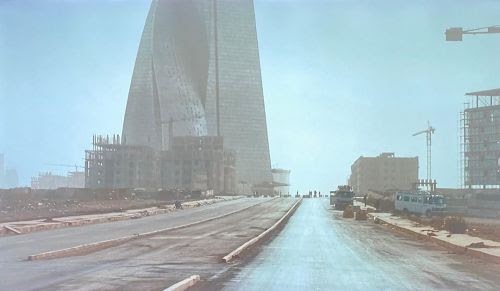
Atlantics, shows the ghost of Colonialism through the construction of a satellite city on the coast of Dakar, Senegal. The skyscraper wrapped in glass hangs on the edge of the city watching a close eye on the workers far below that have to travel for miles everyday from their slum dwellings to the construction sight to be told they can’t be paid and will not be paid for several months due to the greed of the property investors. The men are consequently forced to find a new way to be able to repay debts and help their families by going to sea in search of a new life to substitute for the old one. They die and return as ghosts that haunt the bodies of their girlfriends until they get revenge on the boss who subsequently leads them to a terrifying and inhumane death.
What we see is a city made up of stark divisions. On the one hand you have the millions of people living in sub-slum culture with houses toppling over each over in a maze that interconnects and runs through the city and on the other hand you have the international investors the new wave of tourism culture flowing through the region allowing for a rich luxurious lifestyle but only for the few that can have access to it. The film starts off with the building of a new skyscraper (figure 1.) on the coast of the city standing out for miles with its glossy glass like facade projecting a shiny new future onto the crowded and dust like city. This structure stands alone isolated from the rest of the region, a metaphor for the power relations and hierarchies that flow through the region. With most of the population in poverty, only the rich have access to the lavish luxury that essentially will be built of the cheap labor of those living in the slums in the heart of the city.Vanessa Watson on talking about the new global phenomenon on urban planning in African cities states…
‘However, these new urban visions and development plans appear to disregard the fact that at the moment, the bulk of the population in sub-Saharan Africa cities is extremely poor and living in informal settlements. Some of these settlements are on well-located urban land that is also attractive to property developers. Attempts to implement these fantasy plans within existing cities will (and is already) having major exclusionary effects on vulnerable low-income groups through evictions and relocations. Moreover, these development interests bring with them a host of additional demands − for new and particular forms of urban infrastructure and for forms of governance and decision-making that facilitate the realization of property investment interests’
(Figure 1.)
(Figure 2.)
Atlantics follows the progression of the city Dakar, in the face of new urban landscaping influenced by global finance and western modernism. In the picture featured above (figure 2.) We see the main protagonist Ada, a young teenage girl from a humble working class family. She is to be married to Moustapha, a man with economic wealth as his family is part of the emerging middle class growing in the region which will benefit from the developments being built on the coast of the city. The film follows the story of Ada in a Romeo and Juliet style as she is secretly in love with Souleiman, a working class teenager working to build the skyscraper featured at the beginning of the film. Atlantics portrays the socio-economic differences between stark class divisions. The labor of building the city shows the effects of the post colonial state trying to elevate itself onto the world stage within the idea of an aesthetic of modernism within the bounds of architecture and luxury.
(Figure 3.) (Figure 4.)
In figures 3&4 you can see the evolution of the city, with stable high rise buildings and infrastructure such as roads and pavements being made in order to accomodate for the new satellite city that is being built for the emerging middle and upper classes compared to the shanty town facade in figure 5 were the majority of the people working for the construction of this new city dwell. So what we can see now is a visible power play on the people and Dakar and those who are investing in the new global stage. Using the idea of the skyscraper and the connotations of power that comes with it towering over the city to make a standpoint that it too can be part of the world stage as an attractive global financial area. The postcolonial state has now copied the actions of the french manipulating cheap labor in order to mobilize global influence with a rigid hierarchy that ensures that the ones at the top benefit from the hard work of those at the bottom.
‘It is a fact: every culture cannot sustain and absorb the shock of modern civilisation. There is the paradox: how to become modern and to return to the sources; how to revive an old, dormant civilisation and take part in universal civilisation. – Paul Ricoeur’ The thirst for economic wealth, the thirst for your nation state to be recognised as a first world country is far greater than the costs of the lives of the people whose grandfathers and great grandfathers sacrificed themselves for the independence of what was their born right.
Diamniadio Lake City (Figure.5) is a futuristic $2 billion dollar city being built 20 miles away from the city of Dakar and is to house 350,000 people out of the 14 million people who live in the area. The complex has been commissioned by the President Macky Sall contracting the investment group Semer who are based in Dakar and have partners in the UAE and the USA. The city is to be completed in 2035 with the aim to help cut down overcrowding in Dakar and help revitalize the economy of Senegal. In Neil Brenner and Nik Theodores text Neoliberalism and the Urban Condition they state…
‘As Edward Soja (1987: 178; italics in original) indicated in a classic formulation: Restructuring is meant to convey a break in secular trends and a shift towards a significantly different order and configuration of social, economic and political life. It thus evokes a sequence of breaking down and building up again, deconstruction and attempted reconstitution, arising from certain incapacities or weaknesses in the established order which preclude conventional adaptations and demand significant structural change instead […] Restructuring implies flux and transition, offensive and defensive postures, a complex mix of continuity and change.’
(Figure 5.)
In the 21st Century, Africa’s economy has been increasingly rising due to the amount of material goods that are bought and sold to accomodate for the billions of people that live on the continent. ‘Telecommunications, banking, retailing and construction are flourishing, even booming. Private investment flows are surging. From $9 billion in 2000, foreign direct investment increased to $62 billion in 2008—relative to GDP, this is almost as large as the flows into China.’ This new influx of money allows for more investment opportunities such as the Diamniadio Lake City project to take off to accomodate for the demands and needs of the middle classes and upper classes so they can separate off from the lower class struggles.
‘Even more crucial to the on-going transformations is the rise of middle-class consumer. Today, 40% of the continent’s one billion people live in cities, a proportion roughly comparable to China’s and larger than India’s. It is estimated that by 2035, that share will rise to 50% and Africa’s top 18 cities will have a combined spending power of $1.3 trillion.
The project includes a University, industrial park, housing and commercial services for the targeted middle class audience. The buildings being constructed are all concealed in glass to create a new futuristic hope for the city of Dakar, a new economic awakening. ‘All architectural representation constructs images of nature and order, shapes imagined futures. Seduction carries the implication that desire has been manipulated and that we indulge such desire against our real interest.’
(Figure 6.)
The outer buildings are designed to fit in with the natural fauna that grows around the city’s edges, adding an aesthetic that is shielded by corporate capital. ‘In the world of modern finance, ‘money is water’ writes barna, which helps to explain the mirrored glass and polished surfaces. Since the boom of the early 1990s reflected in this advertising we have seen the development of fluid and crystalline buildings which capture the mythologies of the natural, sustainable and flexible.’ The glitz and glamour of the buildings attract wealth and limit the types of people who can enter the complex.
Satellite cities like Diamniadio Lake City, are usually built in spaces called free zones or an export processing zone, this means that the country can make capital on urban development and attract global investment.
‘The free zone… has become a self perpetuating agent in the growth of extrastate urban space – space beyond the reach of state jurisdictions. Yet, at the same time, it has also become an essential partner for the state as it attempts to navigate and profit from the very same shadow economies. In this form of extrastatecraft, far from overwhelming state power, the zone is a new partner that strengthens the state by serving as its proxy or camouflage.’
Profiting from the complex, the city gains an international reputation as a place where people desire to be. But it also means that these complexes are built on the very foundations of cheap labor. ‘Yet the zone is also capable of organizing a form of labor exploitation that is relatively stable within the law. Workers confront unsafe, strenuous, physically abusive, and psychologically intimidating situations. They have a job, but their wages fail to support a decent standard of living.’ The poorest of society are building for the richest and being pushed further and farther inland until they either have to flee to a different country to have a better life or die.
‘Interventions within current city boundaries set in motion similar processes. Urban developments in Metro Manila involving land clearance for new commercial developments and new elevated transport systems to link them together have been labelled as “bypass-implant urbanism” by Shatkin.(46) These enclaves for the “global class” are designed to avoid and supplant the “failures and decay” of the existing city, and in the process have led to large-scale evictions.’
As much as the complex is good for the image of the country and indeed it will bring in massive profits that will be positive for the economy, the downfall is how and where that money will be spent and who it will be spent on. The corporate structure allows for the complex to be shown in a positive light. The article in Business Insider, suggests ways in which the complex reflects positively on nature, because of the added steel frames draped over the buildings to reflect native Baobabs trees (figure. 6). Or the fact that there will be a 5 star hotel, and a new shopping mall perfect for the middle class shopper. All of this is based on a market for the small percentage of the population that can actually afford it. And although the advertisement of such a development is seen as largely positive because it plans to solve ‘overcrowding’ it is simply a ploy for the corporate model to create power hierarchies within the city system to elevate itself to a standard like that of New York or Shanghai.
Post colonial states use architecture to create a glossy facade of the real problems that are going on in their cities. Corporations are called in to build a temporary, satellite city that will transform the image of the city. Attract more investment because the countries left behind after independence had nothing else. In the wake of the refugee crisis, we see more and more incidents where families, innocent civilians are putting their lives at risk all for the sake of a better life because they are being ignored, treated like ghosts, all for the sake of corporate investment and global reputation. In the year 2020, with the global challenge of the climate crisis and the covid-19 outbreak and the violence whether it be visible or not, I wonder if we will reconsider the ways in which we envision our cities, the way we plan and who, what, where, why and when will we start to prioritise the needs of those who desperately need it rather then use the aesthetic face of luxurious architecture as an image to hide the problems the need to be faced in the current global climate.
Bibliography
Books
David Adjaye Adjaye, Africa, Architecture: A Photographic Survey of Metropolitan Architecture (Thames & Hudson, 2016)
Frantz Fanon The Wretched of the Earth, (Grove Atlantic, 2007)
Gwendolyn Wright, The Politics of design in French colonial urbanism (University of Chicago Press, 1991).
Keller Easterling, Extrastatecraft: The Power of Infrastructure Space, (Verso, 2016)
Kenneth Frampton, Modern architecture: a critical history, (Oxford University Press, 1980)
Kim Dovey, Framing Places: Mediating Power in Built Form, (Psychology Press, 1999)
Robert Adam, The Globalisation of Modern Architecture: The Impact of Politics, Economics and Social Change on Architecture and Urban Design Since 1990, (Cambridge Scholars Publishing, 2013)